CareMatrix: An Integrated Smart Healthcare System
Abstract
The increasing demand for real-time, patient-centric
healthcare has accelerated the integration of Internet of Things
(IoT) technologies with intelligent analytics. Traditional health
care models rely on episodic patient visits and are inadequate for
continuous monitoring and early detection of critical conditions.
This paper presents CareMatrix, an integrated smart healthcare
system combining IoT-based Remote Patient Monitoring (RPM)
with machine learning for real-time anomaly detection.
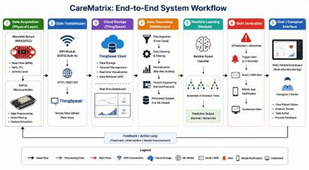
The system utilizes an ESP32 microcontroller integrated with
a MAX30102 sensor to acquire physiological parameters such
as heart rate and oxygen saturation (SpO2). The data are
preprocessed at the edge and transmitted via WiFi to the
ThingSpeak cloud using REST APIs for real-time storage and
visualization.
A Random Forest classifier trained on 10,000 patient records
achieves an accuracy of 92.4%, precision of 91.2%, recall of
90.8%, and F1-score of 91.0%. The system generates alerts within
2–3 seconds upon detecting abnormal conditions, enabling timely
intervention.
The proposed framework provides a scalable and efficient
solution for continuous healthcare monitoring and supports
proactive, data-driven decision-making.
Downloads
References
H. Ben Elhadj et al., ”Do-Care: A dynamic ontology reasoning based
healthcare monitoring system,” Future Generation Computer Systems,
vol. 116, pp. 1–15, 2021.
A. H. Talal et al., ”A framework for patient-centered telemedicine,”
Journal of Telemedicine and Telecare, vol. 26, no. 9, pp. 564–575, 2020.
A. F. Markus et al., ”Explainable AI in healthcare: A survey,” Journal
of Biomedical Informatics, vol. 113, Art. no. 103685, 2021.
H. Carmichael et al., ”Learning from respiratory failure patients,”
Journal of Biomedical Informatics, vol. 117, Art. no. 103744, 2021.
T. Shaik et al., ”Multimodal information fusion for smart healthcare,”
Information Fusion, vol. 86, pp. 57–70, 2023.
W.-C. Yang et al., ”Using medical data for smart healthcare systems,”
Electronics, vol. 12, no. 5, 2023.
A. Ala et al., ”Enhancing IoT-based healthcare using AI,” Engineering
Applications of Artificial Intelligence, vol. 125, 2024.
A. Onasanya and M. Elshakankiri, ”Smart integrated IoT healthcare
system,” Wireless Networks, vol. 25, no. 5, pp. 2455–2467, 2019.
P. Dalal et al., ”IoT-based smart healthcare system design,” IOP Con
ference Series: Materials Science and Engineering, vol. 1025, 2021.
J. Josep et al., ”Cloud-integrated Internet of Medical Things,” IEEE
Access, vol. 10, pp. 1–15, 2022.
A. Abatal et al., ”Semantic smart healthcare system using ontology,”
International Journal of Advanced Computer Science and Applications,
A. Ugale et al., ”Healthcare system using machine learning,” Interna
tional Journal of Engineering Research & Technology, vol. 11, 2022.
M. Daigavhane et al., ”Web-based smart healthcare system,” Interna
tional Journal of Computer Applications, 2024.
W. Zhao et al., ”Smart healthcare systems and applications,” IEEE
Reviews in Biomedical Engineering, vol. 15, pp. 1–20, 2022.
H. Yin et al., ”Smart healthcare: Foundations and trends,” IEEE Com
munications Surveys & Tutorials, vol. 20, no. 3, pp. 1918–1934, 2018.
L. Breiman, ”Random Forests,” Machine Learning, vol. 45, no. 1, pp.
–32, 2001.
J. Han, M. Kamber, and J. Pei, Data Mining: Concepts and Techniques,
rd ed. San Francisco, CA, USA: Morgan Kaufmann, 2012.
I. Goodfellow, Y. Bengio, and A. Courville, Deep Learning. Cambridge,
MA, USA: MIT Press, 2016.
S. K. Sharma et al., ”IoT-based healthcare monitoring systems: A
review,” Journal of Healthcare Engineering, 2023.
R. Rajkomar et al., ”Machine learning in medicine,” New En

This work is licensed under a Creative Commons Attribution 4.0 International License.