Three-Phase Load Balancing Optimization using Mixed Integer-Linear Programming Model: A Case Study at Electrical Engineering Building, University of Lampung
Abstract
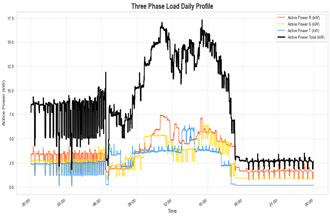
Load imbalance in a three-phase low voltage distribution system is a significant operational challenge and can result in voltage drops and reduced efficiency. Based on the daily three-phase load profile of the electrical engineering academic building at the University of Lampung, particularly during operating hours, the R-phase overloaded (+13.64% deviation). Meanwhile, the S-phase underloaded (-1.70% deviation), and the T-phase underloaded (-11.94% deviation). This study implements an optimization model to balance loads by relocating load units between phases. This model was developed using Mixed-Integer Linear Programming (MILP) framework to produce practical and implementable recommendations. An innovative approach to dynamic load identification is introduced, where the model intelligently determines which loads are active at each time interval based on aggregate power data from the power meter data acquisition system. The optimal solution involved relocating six air conditioning units from the overloaded Phase R (three to Phase S and three to Phase T). This implementation successfully achieved a near-perfectly balanced system, validated by an 11.83% reduction in the aggregate load imbalance metric.
Downloads

This work is licensed under a Creative Commons Attribution 4.0 International License.